Why the condenser water temperature setpoint is such a hard problem
Why the condenser water temperature setpoint is such a hard problem
Welcome to edition three of our Newsletter.
The condenser water leaving temperature setpoint (CDWLT SP) is a single number within the control logic governing the operations of every water-cooled centralised chilled water plant on earth. This is just one of many setpoints required to run the plant safely, reliably, and efficiently, so it is understandable that most people in the industry do not realise how powerful this single setpoint is at driving efficiency.
Adjusting this setpoint (within safe operating parameters, of course) will only impact the speed of cooling tower fans on the roof, barely noticeable to the plant operator, but can drive efficiency gains of 5-15% of total plant power consumption - not bad for updating a single setpoint! One number on a controller is one of the largest single levers on a chilled water plant's energy bill, and the reason it is hard to get right is more interesting than most people give it credit for. In edition three of the Exergenics newsletter, we will do a technical deep dive into cooling tower design, the most common ‘rule of thumb’ optimisation technique and the physics behind our dynamic condenser temperature reset algorithm.
A plant is built for a day it almost never sees
Design day is great. Once a year, sometimes a handful of times a year, the plant gets the hot humid afternoon it was specified for, and it does exactly what it was sized to do. The trouble is, design day is rare. A chilled water plant is built to handle the most extreme conditions in the local climate, an afternoon that might occur around two per cent of total annual operating hours in a typical year. The other 98 per cent, the plant is operating in conditions easier than what it was built for. Sometimes much easier. That 98 per cent is the opportunity. The plant has more capacity than it needs; the outside air is doing more of the work for free, and the question is how to take advantage of it.
What the tower was specified to deliver
A typical design specification might look like this: a 73°F (~23°C) ambient wet-bulb temperature, 95°F (~35°C) condenser water entering the tower, and 85°F (~29.5°C) condenser water leaving. That gives a 10°F (~5.5°C) range across the tower (entering minus leaving) and a 12°F (~6.5°C) approach to wet-bulb (leaving temperature minus ambient wet-bulb). The towers and condenser water pumps serving them were designed to meet these temperatures on the design day, but, importantly, at lower thermal loads and ambient conditions, they are able to deliver leaving temperatures significantly lower than design.

Now picture a cool, dry morning in spring with a wet-bulb temperature of 54°F. The tower is more than capable of producing condenser water well below the design temperature of 85°F. Letting it sit at 85°F, like some plants do when nobody has thought about it, leaves an enormous amount of energy on the floor.
What a “constant approach” strategy actually does
The industry has a standard way to capture that opportunity, and this is the most common strategy we see in the field. A constant approach algorithm is a method for determining the condenser water setpoint by adding a fixed offset to the current outside ambient wet-bulb temperature, typically between 4-8°F. The intent is that the condenser water leaving the tower is always set to be a few degrees warmer than the theoretical minimum, with the strategy being to lower the temperature as much as possible without pushing the fans too hard toward an unreachable setpoint. The target temperature varies with the weather. The approach stays constant. The result is gated between a sensible minimum to avoid chiller choke and a maximum to avoid chiller surge.
Wet-bulb plus 4-8°F is a genuinely good heuristic. For many plants, it is a massive jump in efficiency compared to a constant CDWLT setpoint, and for much of the operating year it lands close to energy-optimal. But it is still a one-input rule with an offset either chosen arbitrarily or iteratively through human trial-and-error style tuning. It only ever sees one input variable: ambient wet bulb. Everything else that affects the optimum SP is invisible to it. That is the gap this edition is about.
It is not a tower problem. It is a chain.
To see why one input is not enough, you have to stop thinking about the tower in isolation. The cooling tower is the last step in the chain. It rejects heat to the atmosphere, almost entirely through evaporation. A small fraction of the condenser water changes phase, and the latent heat it carries cools the rest. The air leaving the tower is barely warmer than the air entering, but it is nearly saturated. That is why ambient wet-bulb temperature is the binding constraint, not dry-bulb temperature. You cannot drive condenser water below the wet-bulb temperature, no matter how hard you run the fans.
The condenser water leaving the tower feeds straight into the chillers, and the chillers are the much larger energy consumers. The temperature of the water entering the chiller determines how hard the compressor has to work. Make the water colder, and the chiller draws less. Push the fans harder to get colder water, and the tower draws more. The two sides are coupled. You cannot evaluate one without the other. A useful framework for thinking about this single setpoint is the balancing of work done between the cooling towers and compressors inside of the chiller(s); the differential temperature (Δt) will dictate how much work is required, but ultimately it must be done somewhere - so how do we get that balance right?
Backing off fan speed pays back on a cube
Assuming normal condenser water flow rates at or near design - pulling more air through the tower will reject more heat. Pull less, and you reject less. The fans consume real energy to run, and they do so on a very steep curve. Fan power scales with the cube of speed, so a fan running at 80 per cent of full speed draws roughly half the power of a fan at 100 per cent. Small reductions at the top of the curve buy you very large savings.
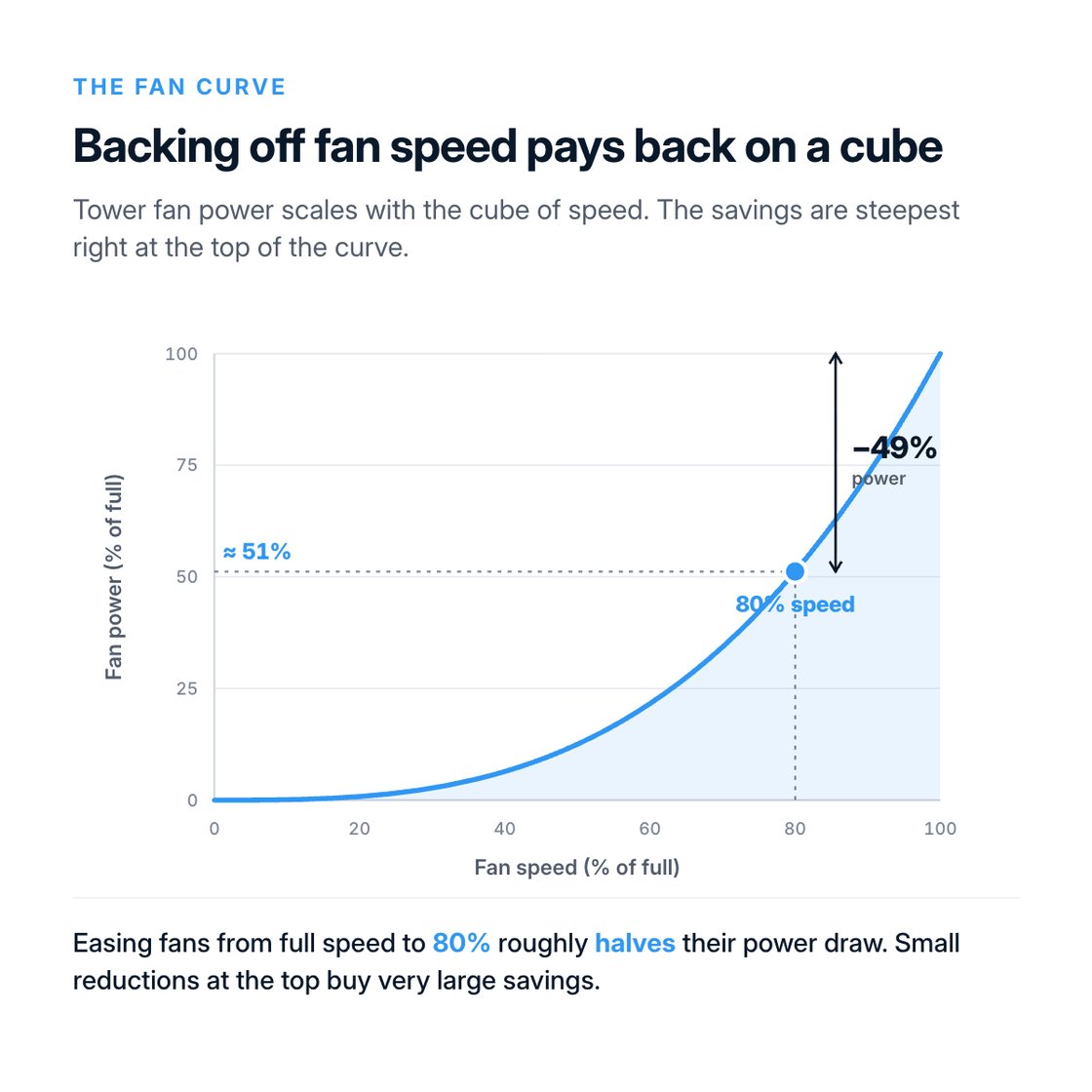
This is the lever on the tower side of the equation. Letting the condenser water setpoint drift up means the fans can slow down. Even a few degrees of headroom can be worth a lot of kW. This is another common strategy we see out in the field, limiting cooling towers to 90% speed to avoid the steepest part of the curve.
The same degree of lift is worth different amounts
On the chiller side of the equation, efficiency is a function of part loading and lift, the pressure differential the refrigerant has to be pumped against. Lift is fundamentally driven by the temperature difference between the chilled-water loop and the condenser-water loop. Drop the condenser water temperature, and you drop the lift. Drop the lift, and the compressor does less work for the same cooling effect.
The catch is that not every chiller responds the same way. A modern magnetic bearing centrifugal at 40 per cent part load gives you huge efficiency gains for every degree of lift you take out. A constant-speed screw chiller at 85 per cent part load barely moves. The response to changes in lift is also not uniform for a given machine; depending on the part loading, it can deliver huge or modest benefit, which means the answer to “how much energy do I save by dropping the setpoint a degree?” depends entirely on which chiller (or combination of chillers) is running and how loaded it is.
Add the two curves, and you get a bowl
Put the two sides together. The chiller draws less as the condenser water gets colder. The fans draw more as you push the towers harder to deliver it. Add them at a given operating condition, and you get a bowl. The bottom of the bowl is the optimal setpoint; sounds easy, right?

The optimum balances the two sides of an energy trade-off. Move left of it, and you are paying for chiller efficiency you do not need with disproportionate fan energy. Move right of it, and you are giving the chiller more lift than the fan savings make up for. A strong optimisation must be agnostic about which piece of equipment uses more or less energy; all we care about here is system-level efficiency to find the sweet spot that balances the two halves of the system perfectly.
There is one best setpoint… but it never sits still
The bowl moves. Ambient wet-bulb sets the theoretical floor for how cold the tower can deliver, and it changes the air density and L/G ratio relative to the tower’s characteristic curve. Building load changes the total number of tons of heat that need to be moved. Which chiller is running and at what part load changes the shape of the chiller curve and therefore the location of the bottom of the bowl.
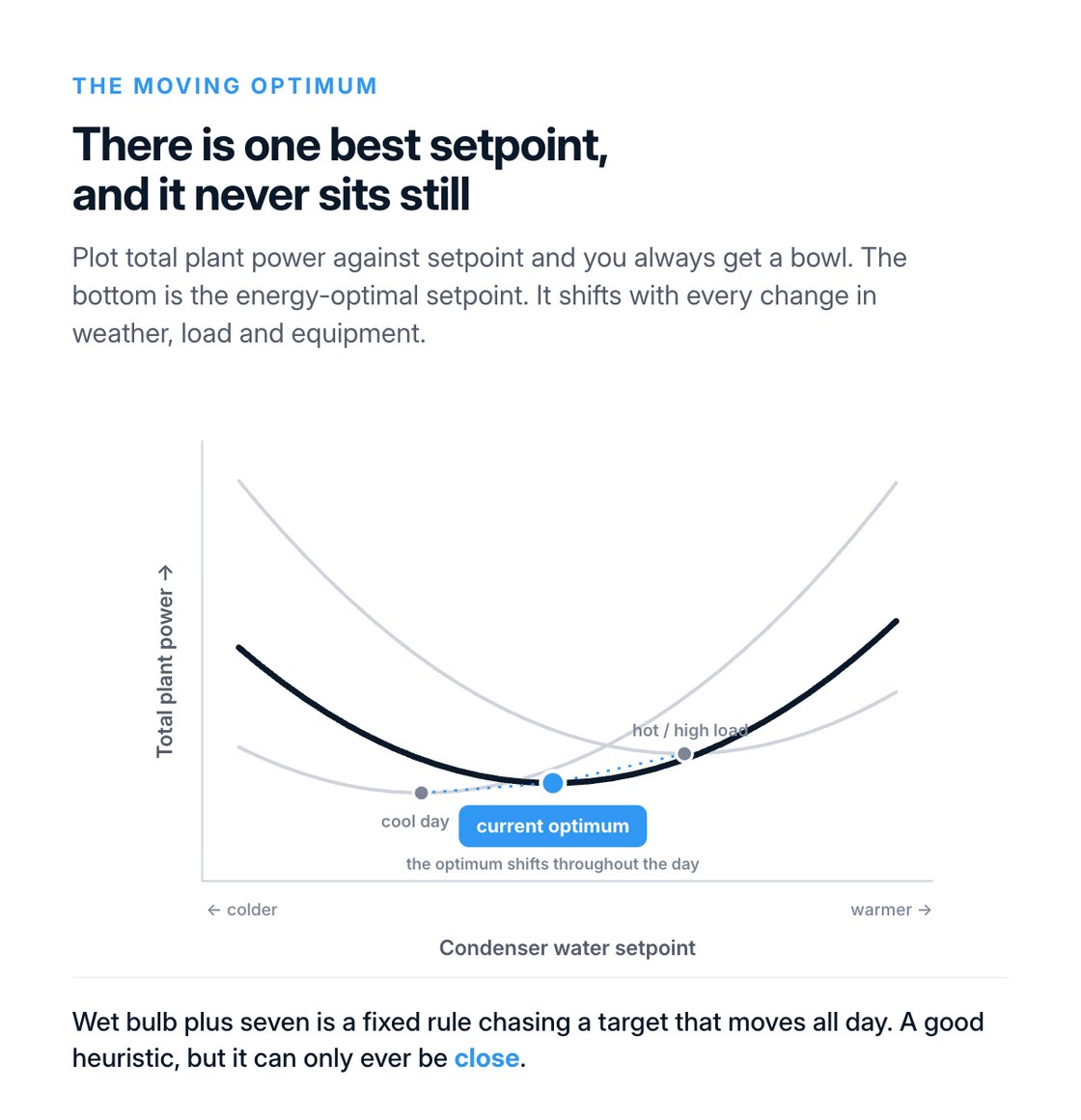
Picture a typical plant. Three or four chillers of mixed type and sometimes mixed vintage, sharing a common header on the condenser side, fed by a bank of cooling towers also on a common header. On any given afternoon, you might have a magnetic-bearing centrifugal chiller and a screw chiller at around 50 per cent each, and a wet bulb that has shifted by 8 degrees since the morning start-up. What is the right setpoint? It depends on which chiller benefits more from lower lift, what the fans cost to drive the setpoint down to that level, how the load is split across the chillers, and where each chiller is sitting on its own non-linear efficiency curve. A constant approach algorithm cannot see any of that. It knows wet bulb and the offset, and that is the end of the list.
Solve the hard problem once. Run the answer forever.
The way we approach this at Exergenics is a nested loop. For every combination of available equipment, every possible thermal load, and every wet-bulb across the operating envelope, we search for the setpoint that minimises the total system kW. Tower fans, condenser water pumps, chillers, all rolled into one objective function. The result is a multi-dimensional data cube: for any operating condition you can name, an optimal condenser water leaving temperature.
A data cube is not a control system, though, and that is the next step. For each staging option (which chillers are running together), we perform a regression on the optimal plane to find an algorithm that produces the optimal setpoint based on known input variables available in the BMS: thermal load (Tons or kWr) and wet-bulb temperature (°F or °C). What comes out is a clean piece of control logic in a shape any BMS can run. This is an important point to state explicitly; in control theory there is always a trade-off between complexity, transparency and efficiency - we strongly believe this structure of optimised output finds that balance nicely between striving for optimal and giving operators the oversight they need to feel comfortable about how their plant is operating.
.png)
Exergenics condenser water temperature algorithm in action.
Curious to see more?
A static algorithm that produces a dynamic answer
This is where the deployment model matters. The control logic is static. It does not change. It has been computed during pre-training, regressed and written into the controller. There is no cloud connection, no gateway, no live agent sitting in the loop. But the control is dynamic. The setpoint resets continuously, every minute of every day, based on what is actually happening at the plant: which chiller(s) are running, what the load is doing, and what the wet bulb is outside. Operators can read the algorithm, interrogate it, and see exactly why the plant is behaving the way it is. It is dynamic optimisation living on the edge, with no black box.
That is the trick. Solve the hard problem offline, once. Hand the plant a small set of readable algorithms that reproduce the answer in real time. Wet-bulb plus 4-8°F is a sensible default. What we deliver is a setpoint policy that respects the physics inside and the reality of controls outside.
That is it for edition three; if you made it this far, congratulations, you’re a true HVAC nerd! If you have solved this problem differently, or have a different control philosophy you think is worth a look, hit reply. We read every one.
Thanks for reading,
Iain Stewart
Cofounder & CEO, Exergenics
www.exergenics.com